Business class from the UK is not one product at one price. The cabin changes with the aircraft, the fare changes with the airport you leave from, and the gap between the two cheapest ways to buy the same seat is often larger than the gap between two airlines. Those decisions are what we price for you, rather than leaving you to guess at them.
We are a UK premium-cabin agency. Business and first are not a sideline here; they are the work. Whether it is Heathrow to New York for a board meeting, Manchester to Dubai for a wedding, or a once-in-a-decade trip to Sydney in a flat bed, the job is the same: the right itinerary, priced properly, with the trade-offs said out loud.

What business class actually buys on a long-haul trip
On a short European sector it usually means a wider seat, a hot meal and lounge access. On a fourteen-hour sector to Asia or Australia it should mean a fully flat bed, a proper dining service and a cabin built so you can sleep. Those are different products sold under one name, and the one you get is decided by the aircraft operating your dates.
The useful question is therefore not "is this airline good" but "what is fitted to the aircraft flying my route on my date". That is a question with an answer, and we confirm it before you commit.
The seat is an aircraft question, not an airline one
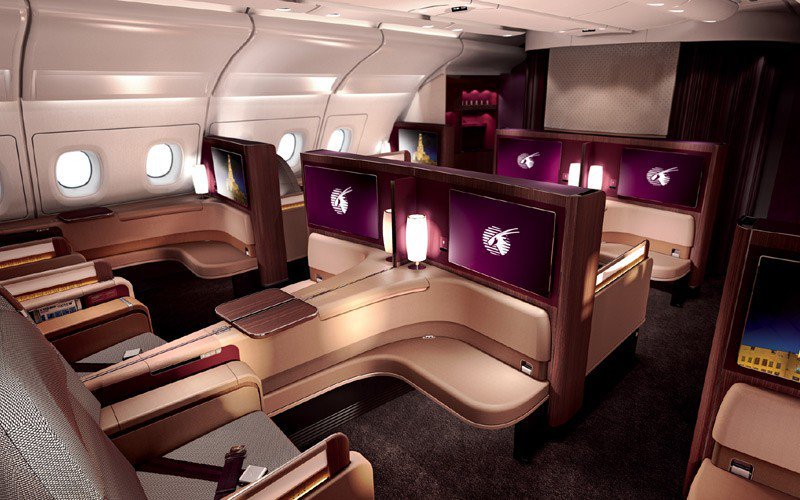
The clearest examples are the ones people get caught by. Qatar's Qsuite — a closing door, a 1-2-1 layout, a centre-pair double bed — is fitted to equipped aircraft only, so two flights on the same airline can carry different cabins. Emirates' onboard bar is an A380 feature rather than an airline feature, and older Emirates 777 layouts can leave some business seats without direct aisle access. British Airways' Gatwick 777 fleet has not received Club Suite, so a Gatwick departure is likely to carry the earlier Club World layout rather than the newer seat with a door.
None of that is a reason to avoid any of these airlines. It is a reason to confirm the aircraft type before you pay, especially on a long overnight sector where a door and direct aisle access are the difference between sleeping and not.
Where you fly from changes what you pay
Most travellers assume Heathrow is the cheapest place to start, or close enough. On a surprising number of routes it is not, and on some the order inverts completely.
On current guide fares the cheapest UK departure is not London for Delhi, where Birmingham leads and London is the dearest of five; nor for Bangkok; nor for Abu Dhabi or Jeddah; nor for Hong Kong or Tokyo, where Glasgow is cheapest. The figures move, so each destination page carries its own with the date it was checked, and how our fares work sets out where those figures come from.
The inverse is worth knowing too, because it saves you effort. Dallas carries one of the flattest UK departure ladders we quote, so choose your airport on convenience there. Phoenix is the opposite extreme, where the choice of departure airport dominates the fare.
Tell us your own airport rather than the one you assume is cheapest. It is the single most useful thing you can do before we price anything.
Business class, premium economy or first
Our fares split into two groups here, and the split does not follow distance. On routes like Langkawi, Mauritius and Delhi, business costs barely more than premium economy — so dropping a cabin saves very little and costs you the flat bed. On the big American routes business runs at roughly double, which is where premium economy genuinely earns a place on the shortlist.
The same logic runs upwards, and it is the reason first class from the UK has its own page: the step from business to first is a different decision on every route, and on a few it is much smaller than people expect. Ask what the first fare actually buys on your dates rather than treating the gap as the price of an upgrade.
Where we quote business class
The regional guides set out which arrival airport to choose and what each route involves before you look at a fare:
- Business class to the USA — thirty American arrivals, and the airport codes that catch people out.
- Business class across Asia — where the long sector falls, and which cities have more than one airport.
- Business class across the Gulf — the hubs that also serve as connecting points for everything beyond them.
- Business class to Australia and New Zealand — the longest journeys we sell, where the routing shape matters most.
- Business class to Africa and the Indian Ocean, the Caribbean and Canada.
- Business class to Thailand — which arrival, and what actually flies it.
The airlines we book most
Each guide covers the cabin, the UK departure map and the aircraft question for that carrier: Emirates, Qatar Airways, British Airways, Singapore Airlines, Etihad Airways, Cathay Pacific and Virgin Atlantic.
We are not tied to any of them. Where a published airline fare is the better option, that is what you will be offered.
How a booking works
- You tell us the trip. Cities, rough dates, the real boundaries of your flexibility, and your own departure airport.
- We price it. Usually your preferred itinerary against one credible alternative, so the trade-off is visible before you commit rather than implied afterwards.
- We confirm the detail. Aircraft type, what each sector actually carries, and the fare conditions that apply.
- You confirm. We hold seats where the market allows, take passenger details, and issue the tickets.
- The same desk stays with it. Schedule changes, seat requests and post-ticketing questions come back to the person who booked it.
There is no fee to enquire and no obligation to book. Typical response time is under an hour on UK business days.
Financial protection
Experts Business First is ATOL protected. The protection that applies to any particular booking depends on how that booking is sold, so we state it on your quote and again on your confirmation before you pay anything. If you are unsure what covers your itinerary, ask us before you pay rather than after — we would far rather clarify it than have you assume.
What to tell us when you enquire
- Every city in the trip, so a multi-city itinerary can be built as one ticket rather than two separate returns.
- The actual boundaries of your flexibility. "Any time in March" and "the 14th or 15th" are completely different briefs.
- Your own departure airport, plus any others you would accept.
- Whether you want premium economy priced alongside business.
- Anything non-negotiable — a flat bed, a daytime arrival, a particular alliance for status.
Ready when you are
If you know the trip, even roughly, the enquiry form above is the fastest route to a real quote. If you would rather write it out, call +447348617176 with your dates, airports and any airline preferences, and we will come back with business class options you can actually use.
For a wider view of the levers that move a premium fare, see what actually changes what you pay from the UK.