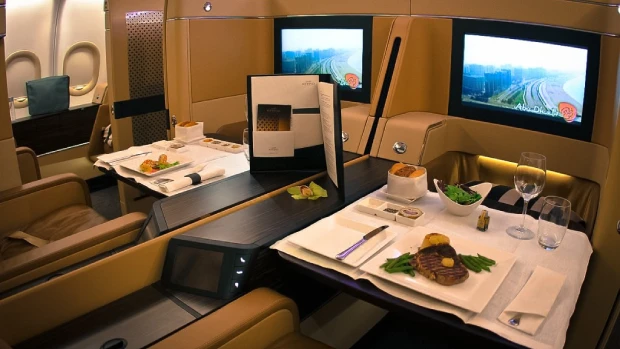
First class is not simply more business class. It is a narrower product, fitted to fewer aircraft, and on some routes it is a far smaller step up than the price difference suggests — while on others it is the only cabin that does what you actually need. Telling those apart before you spend the money is the whole job.

The first thing to know: not every aircraft has a first cabin
Fewer airlines sell a true first class than most people expect, and within those airlines fewer aircraft carry it. A first cabin is fitted to particular aircraft types rather than offered across a whole network, so the same airline on the same route can be a first class flight one day and a business class flight the next.
This is why we will not publish a list of carriers and call it an answer. Name the city and the dates, and we will confirm which airlines genuinely sell a first cabin on that routing before you plan anything around it.
What the step up actually buys
The cabin itself is the obvious part: far more space, a proper bed rather than a seat that converts into one, and on the newest products a fully enclosed suite. The less obvious part is usually what people end up valuing most.
- Ground service. Separate check-in, a different lounge, and on several products a shorter, quieter path from the door to the aircraft.
- Cabin density. A first cabin is small by design — often a handful of seats. That changes the service ratio and the noise level far more than a seat diagram shows.
- Dining on your schedule. Ordering when you want to eat rather than when the trolley arrives is the difference on a long overnight.
When business is the better ticket
We would rather say this plainly than sell you the wrong cabin. On several routes the gap between the first fare and the business fare is much narrower than people assume, and Cape Town is the clearest case we quote. A narrow gap is not automatically a bargain — it can also mean the first product on that route is closer to a very good business cabin than to a flagship suite.
So the question to ask is what the first fare buys on your specific dates, not what the difference between two numbers implies. If the honest answer is "a slightly larger seat", we will tell you, and business class from the UK is the better ticket. If the answer is a genuine suite on a fourteen-hour overnight, that is a different conversation.
The trips people actually book it for
First class sells for reasons business class does not. Honeymoons and anniversaries, a once-in-a-decade family trip, a milestone birthday, and the long-planned journey where the flight is meant to be part of the holiday rather than the toll paid for it.
The other pattern is the arrival that cannot be compromised: landing to present, to operate, or to be somewhere for a fixed hour after a fourteen-hour sector. If the cost of arriving unfit is high enough, the cabin stops being a luxury question and becomes a scheduling one.
Where you fly from is still worth asking about
The London assumption costs money in premium cabins generally, and first is no exception. Before you fix a departure airport, ask for your own to be priced alongside it — the business page sets out how much the departure airport can move a premium fare, and the same principle applies here even though the first cabin exists at fewer airports. Every figure we publish is a dated guide fare; how our fares work explains what that means and what moves it.
Where we can quote a first class fare
We can price a first class itinerary to every destination we cover. The regional guides are the fastest way to settle which arrival you actually want first:
- The USA — thirty arrivals, and several cities where the airport code decides which state you land in.
- The Gulf — the shortest long-haul sectors on which a first cabin is commonly available from Britain.
- Asia and Australia and New Zealand — the longest journeys, where the cabin matters most and the routing shape matters nearly as much.
- Africa and the Indian Ocean, the Caribbean and Canada.
How a first class booking works here
- We check availability before anything else. On first that is the binding constraint, not the fare — a cabin of a few seats sells out in a way a business cabin does not.
- We price first against business on the same dates, so the decision is made with both numbers in front of you.
- We confirm the aircraft, because the product follows the type and a schedule change can quietly move you to one without a first cabin at all.
- We hold where the market allows, take passenger details and issue the tickets.
- The same desk handles the trip afterwards — schedule changes, seat requests and anything that moves.
Financial protection
Experts Business First is ATOL protected. What covers any individual booking depends on how that booking is sold, and we set it out on your quote and on your confirmation before you pay. On first class itineraries the sums involved are larger, which is exactly why it is worth reading that line rather than assuming it.
Ready when you are
First class rewards asking early, because availability runs out before price does. Use the enquiry form above with your cities and rough dates, or call +447348617176 — tell us the occasion as well as the itinerary, since it often changes which routing is worth recommending.